
#BlackWomeninBullCity | Ersaline Williams & The Sojourners for Truth and Justice
This blog post was inspired by my desire to learn more about the role that black women have played in the fight for the liberation of black people everywhere from injustice. I've been able to spend more time reading more books, and I've rediscovered my love for historical literature on my people and our struggle, specifically, black women's historical writing. We can't continue fighting for justice while not reading books and literature based on the perspectives and experiences of black women. I was triggered by the story of our sister Toyin Salau who sexually assaulted and then murdered. There are many other countless stories of black women who have experienced sexual violence at the hands of men that we do and do not know. Furthermore, there have been SO many of us who have been survivors of sexual violence telling our stories but not even having the support of the black men who we defend and fight for every chance we get.
This devastates me.
I wanted to begin by gaining a firm understanding of how women from my hometown, Durham, North Carolina, also known as Bull City, organized for the sake of bringing justice to their communities. Durham was considered to be "capital of the black middle class" in the 1920s and garnered the praise of renowned leaders, Booker T. Washington and W.E.B Du Bois. It is the home of the largest black-owned financial institution in the country, North Carolina Mutual Life Insurance Company. While many of Durham's black male elite's achievements are important to note, the efforts and organizing, accomplishments, challenges, and injustices faced by black women in the City of Durham have made been invisible and overlooked.
My purpose in writing this blog is to serve as an introduction to a longer-term project to begin to highlight and share more about the history of black women's work in Durham, to seek justice for themselves, their families, and their community from past to present. Much of what I will be sharing comes directly from books, publications, and media that covered the experiences of black women in Durham. When I share the information, I will ALWAYS attach the sources.
For today I wanted to highlight the story of Ersaline Williams.
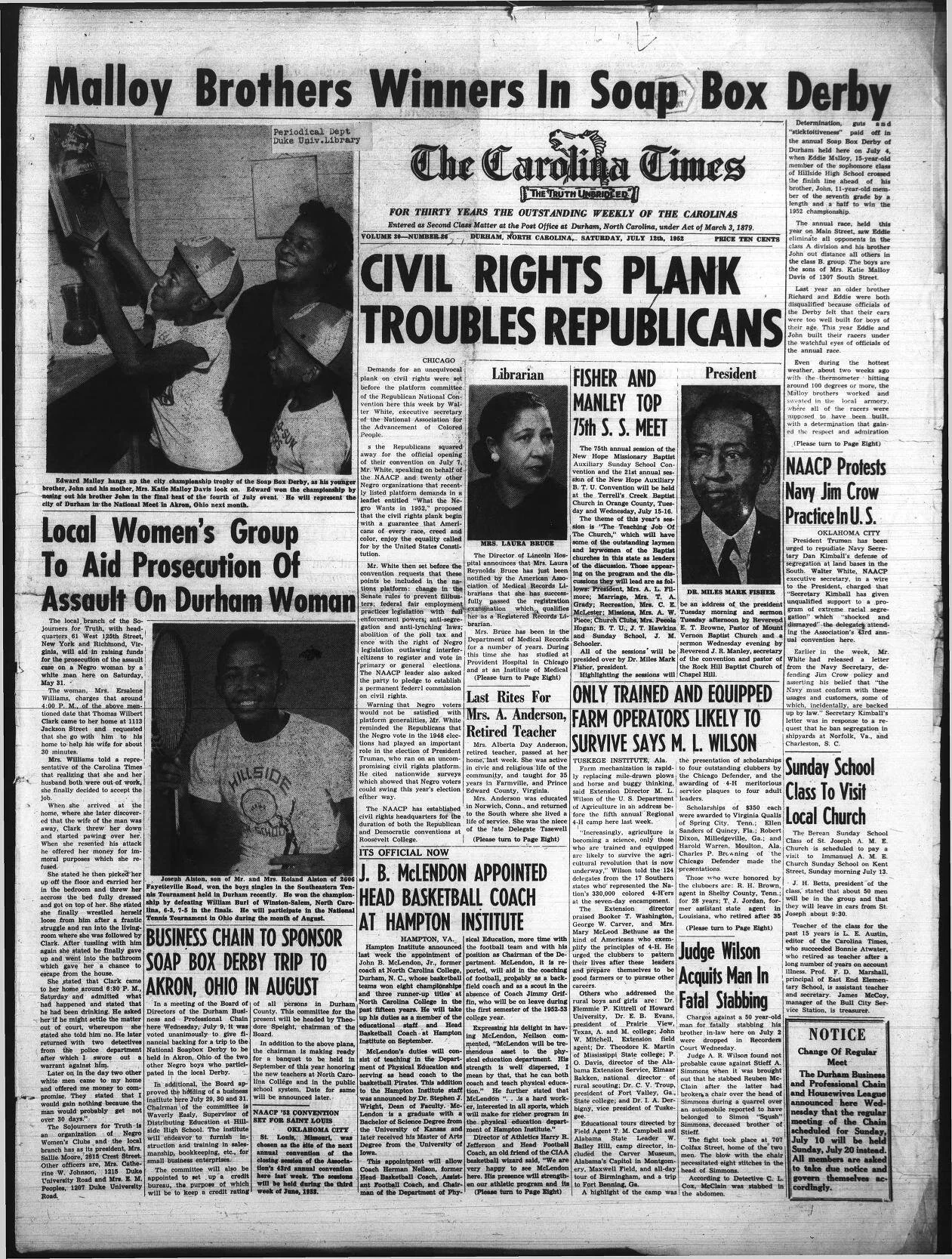
http://newspapers.digitalnc.org/lccn/sn83045120/1952-07-12/ed-1/seq-1/
In 1952 Ersalene Williams, a black woman in Durham searching for work was asked by Thomas Wilbert Clark, a white man, to assist his wife with some household chores. She agreed, but when she arrived, Mr. Clarke's wife was nowhere in sight...
Mr. Clarke pounced on Ms. Williams without warning. When she rejected his "pawing", he offered her money for "immoral purposes" by the press. Ms. Williams, horrified, kicked and screamed, while Mr. Clark dragged her into the bedroom, tossed her on the bed, and got on top of her. During a "frantic struggle", she managed to free herself and escape. Soon after, Mr. Clark appeared at her home to apologize, explaining he had been drinking and could just forget about it. Ms. Williams refused, and Mr. Clark then returned with two white detectives hoping to intimidate her. His plan backfired, and Ms. Williams swore out a warrant for Mr. Clark's arrest. She then said, "Later on in the day, two other white men came to her home and offered me money to compromise. They stated that I would gain nothing because [Clark] would probably [not get more] than 30 days. During the time, Durham's traditional middle/upper-class black male leadership remained silent in the case of the attack on Ersalene Williams. Durham's weekly, The Carolina Times, denounced the black male elite for their silence. Durham's Sojourners for Truth and Justice, a local African American women's group rallied behind Ms. Ersaline in the fight for justice and truth.
The story and assault of Ersaline Williams were all too common for many black women in the south. This type of sexual and racialized violence has plagued our black women for centuries. There is still a struggle to protect black girls and women that shall remain as a priority in black liberation. Unfortunately, black women remain disproprotionately vulnerable to sexual abuse due to intersectionality, the systematic oppression that black women experience based upon the intersection of their race and gender. These institutionalized practices and policies prevent equitable enforcement. The "Strong Black Woman" stereotype, that focuses primarily on uplifting black women through their strength, perseverance, and survival and minimizes their emotional well-being, tenderness, and humanity further promotes silencing the pain of black women and girls.
According to the National Center on Violence Against Women in the Black Community (PDF, 772KB):
For every black woman who reports a rape, at least 15 black women do not report.
One in four black girls will be sexually abused before the age of 18.
One in five black women are survivors of rape.
Thirty-five percent of black women experienced some form of contact sexual violence during their lifetime.
Forty to sixty percent of black women report being subjected to coercive sexual contact by age 18.
Seventeen percent of black women experienced sexual violence other than rape by an intimate partner during their lifetime.
The Institute for Women's Policy Research reports that:
More than 20 percent of black women are raped during their lifetimes — a higher share than among women overall.
Black women were two and a half times more likely to be murdered by men than their white counterparts. And, more than 9 in 10 black female victims knew their killers.
Black women also experience significantly higher rates of psychological abuse — including humiliation, insults, name-calling, and coercive control — than do women overall.
You may ask yourself, What can I Do? Here are some suggestions to start with:
Become an informed ally. Learn about the relationship between colonialism and sexual violence. Read more books by black women scholars who are writing about the lived experiences of black women, including sexual abuse. #CiteBlackWomen is a good start.
Center black women in your advocacy. Contact elected officials. Ask them what they are doing specifically to improve the sexual violence experienced by black women. It may be helpful to explain how institutions contribute to gendered racism. Ask them to reauthorize the Violence Against Women Act.
Support local grassroots organizations that work on behalf of black women in your community. This may require you to do some research, talking with black women, and allowing them to tell you what they need.
Black women should not be forgotten survivors of sexual violence. It's 2020, and it is time that we begin to build capacity in local, regional, and national communities to create sustainable change and end sexual violence against black women everywhere. This story is symbolic of the legacy Durham's African American women have created in the fight for justice. It also highlights the importance of black women's community work and organizing in the Freedom Movement for black folks in America. I'm excited to continue to share more about the history of black women in Durham. If you have more information on Black women from Durham, NC, and would like me to highlight their stories as a part of the Black Women in Bull City project, please fill out the contact form on my website and Let's Connect!
Sources:
NC Newspapers: http://newspapers.digitalnc.org/lccn/sn83045120/1952-07-12/ed-1/seq-1/
NC Digital Heritage Center
Our Separate Ways by Christina Greene: https://www.amazon.com/Our-Separate-Ways-Movement-Carolina-ebook/dp/B001P82APY
https://www.apa.org/pi/about/newsletter/2020/02/black-women-sexual-assault