
#BlackWomeninBullCity | Ann Atwater
Since beginning my journey to research and learn more about black women from Durham, I have found myself deeply moved by their tenacity and persistence in the fight for justice for our people. I’m a believer that your roots control your fruits and learning more about my hometown, and the rich history and legacy that is there give me something to hold onto as I’m going through my journey as a young black woman striving to achieve her wildest dreams.
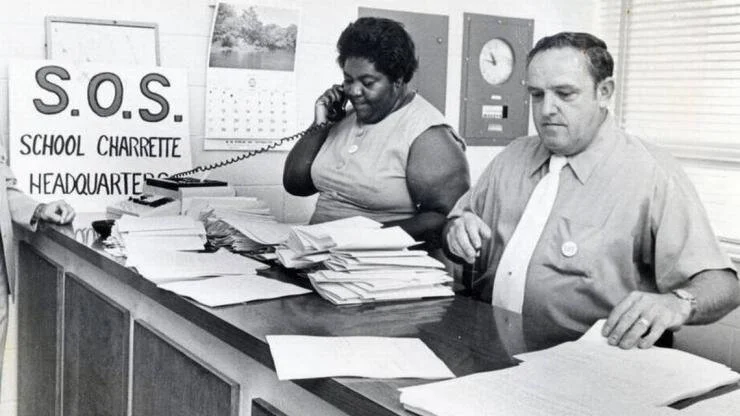
Photo from the University of North Carolina Chapel Hill Libraries
This week I will be sharing a little bit about Ann Atwater originally from Columbus County, NC. She came to Durham in 1950. Her husband and one child were sharing one room with two beds that was occupied by another man. They moved around a lot living in substandard housing and ended up living with a woman sleeping on a small couch while pregnant with her second child. While pregnant with her second child, her husband then left her to go to Richmond, VA. But Ann persevered and was able to move out and get a two-bedroom apartment of her own, doing domestic work, and she was paying $6 a week for rent. She was working for white women cleaning her house for 30 Cents an hour.
And she was naked that morning, I went up and the mailman, the milkman and I both came up at the same time, and she was screaming, and so I told him, I wasn’t going in there, he said he wasn’t either, he just set the milk down and left. And I turned around and I left so I wouldn’t go back any more, because I didn’t know what was wrong with her.
Ann was able to get the assistance of $57 a month for her and her two girls from the Department of Social Services. That was just enough for bills but only some basic living needs. Ann says,
“ They didn’t allow me to have a television at that time, and so I made a, trying to pay my bills with that $57 a month, and we would have, we would eat like rice and maybe I’d take fried fatback and take the gra-, take flour and make gravy, and we’d have rice and gravy and fatback like today and tomorrow I’d probably cook a cabbage and then Wednesday I would have the rice, cabbage, whatever was left over we ate, that’s the way I fed the children. And I used cloth bags, flour bags and rice bags, to make their clothes, to make the slips and the dresses and things out of.
Ms. Atwater, like many other poor black residents of Durham, found her self living in unsafe and unhealthy conditions. She was living on Fowler Avenue where the house had cracks along the side, and it was so poorly wired that when her lights were cut off for her inability to pay, she could just stomp on the floor and lights would come on and she would stomp again and the lights would go off; this continued for about a year. Howard Fuller, a member of the NC Fund, approached her about getting her house repaired. She took up his offer to come to the meeting about how the fund would help him organize 23 neighborhood councils. She was able to get her home repaired after Mr. Fuller had come and requested the landlord to make some repairs, but she said rent went up every time something was fixed.
Every time they would patch up something they would go up on the rent. And this is what everybody was faced with.
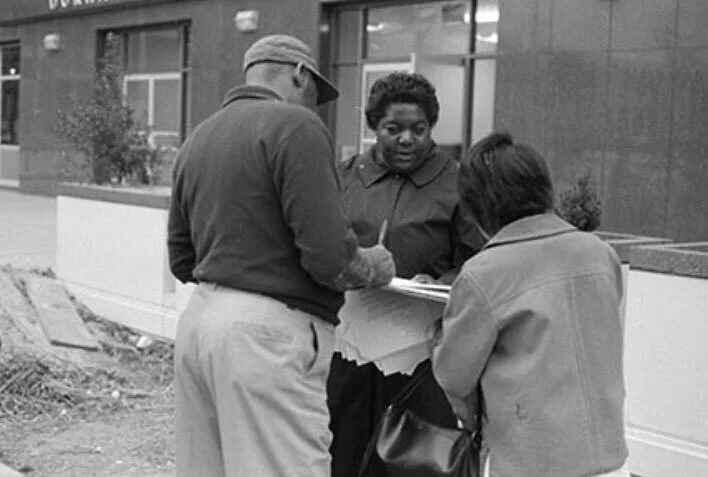
That experience empowered Ann, and after that night, she would go door to door telling people how they get the landlord to fix their homes, and she then started helping to build the neighborhood councils off of that. She was apart of the groundwork and laying the foundation for influential neighborhood councils. After going through a 17-week training program, she became a Community Action Technician, and her focus was housing. Her supervisor told her to get a picket line and have the tenant selection, and housing authority fired. She gathered about 300 people with picket signs and went marching around the housing authority’s office.
In addition to serving as a community technician, she served with Operation Breakthrough, which taught people how to register to vote and the importance of voting. She served on the board of directors of OB for seven years. After her time on the board, she began working as a social worker for the headstart program. Ms. Atwater advocated for people all across Durham, and they called her “the breakthrough woman “ because she was getting things done for people. Ms. Ann has stopped the illegal eviction of families, forced the housing authority to accept women with illegitimate children and people with police records, and stood on the belief that further ghettoization of black communities had to stop. Although she had all of this under her belt, she still had to fight to keep her job. They were willing to give away jobs to more educated people with no experience rather than someone like herself who had, for a long time, been organizing and making things happen for the blacks in Durham.
She went to North Carolina Central University and demanded that they put community work in their curriculum for the social work student to gain hands-on experience and not do this work just learning from the book. She fought against the building of the Durham Expressway, which uprooted many blacks our of their communities. Ms. Ann was also elected a the vice-chair for the democratic party but couldn’t make all the meetings and another black woman who could pay the group money to gain the position. She explains that this ability to pay their way into the room allowed them to remain in positions, whereas most poor blacks could not do that.
In 1967 Ms. Ann Atwater was named Woman of The Year for her work in the community. When the American Federation of Labor and Congress of Industrial Organizations (AFL-CIO) gave a grant to North Carolina to integrate the schools, Ms. Atwter was called on to pick up folks in the neighborhood to bring them to the meetings. Upon arrival, she was faced with dealing with Mr. C. P Ellis, a leader in the local Ku Klux Klan group trying to prevent them from coming together on integration who said:
“Them niggers ought not to be on this side of the track.” And I walked in and I said, “Well, you crackers ought not to be up here talking either.” And we started calling one nigger and cracker, and we don’t that for about 2 weeks, and we couldn’t get really anything done.
Ellis had spoken on NPR that Atwater was an" effective boycotter, making progress, and he hated her guts." Ms. Ann wrote in a column that a couple of years before joining the committee to desegregate, she nearly slit his throat at a city meeting after he repeatedly used the n-word. Luckily, her pastor was there, grabbed the hand holding the knife, and stopped her. After they were able to get over fighting with one another, they were ready to come together and start searching the schools finding out that many of them were supporting their husbands' schooling at Duke to become doctors. Many were not placed in the right classes, many who were math teachers were teaching English, and so on. White people at the time didn't want those changes. Over time and with many obstacles, they were able to integrate the schools successfully. Atwater and Ellis became friends, and after attending a charette together on the final night, Ellis renounced the Ku Klux Klan and never returned. The story of their friendship is depicted in the film, The Best of Enemies featuring Taraji P. Henson.
Ms. Ann Atwater's work in Durham to bring equality and justice to people of Durham is a model of transformational leadership by which we can all take notes from. Her story and her life's work is one of resilience, diligence, and truth. Ann Atwater is a woman who has reminded to find and use the power of my voice. This is just a peek into her life's work in Durham, and if you'd like to learn more below, I have attached some resources to learn more about her.
Sources:
https://www.schoolforconversion.org/ann-atwaterin-her-own-words
https://www.ncdcr.gov/blog/2020/01/28/activist-ann-atwater
https://www.ncpedia.org/atwater-ann-george
https://allthatsinteresting.com/ann-atwater