
#BlackWomenInBullCity | Doris Lyon
Leading up to World War II, racial tension was rising in and across the south between black and white people. One area where it was a continuous struggle when it came to the sharing of public spaces, in particular transportation. Black women were the ones to challenge Jim Crow practices within the transportation sector because the majority of the reliable on bus transport to get to their domestic jobs. During this time in Durham, the racial hostility and disharmony on public transportation had become so bad that chairman of the state utility commission complained to the then Governor Broughton stating that
Durham is one of the worst places we have, due to the large negro population, and to the fact that there are many northern Negro soldiers at Camp Butner and also northern white officers who do not agree with our segregation laws and encourage the negro soldiers to violate them.
He added that it was "utterly impossible" for bus drivers and police in Durham to "to enforce segregation laws saying that "we have already had some open trouble there, and I apprehend that we will have more. It is a bad situation". There were many southern blacks who believed any aggressive or direct action would provoke white rage, with the ongoing hostility many grew dissatisfied with segregation, and protests and demonstrations became more widespread. In 1938 Ellen Harris, a Durham woman brought a case against the local bus company when a white male passenger demanded that she move to the back of the bus. The Durham NAACP failed to take her case. However, the court ruled in her favor ruling that she had not broken violated the Jim Crow laws not that segregation was unconstitutional.
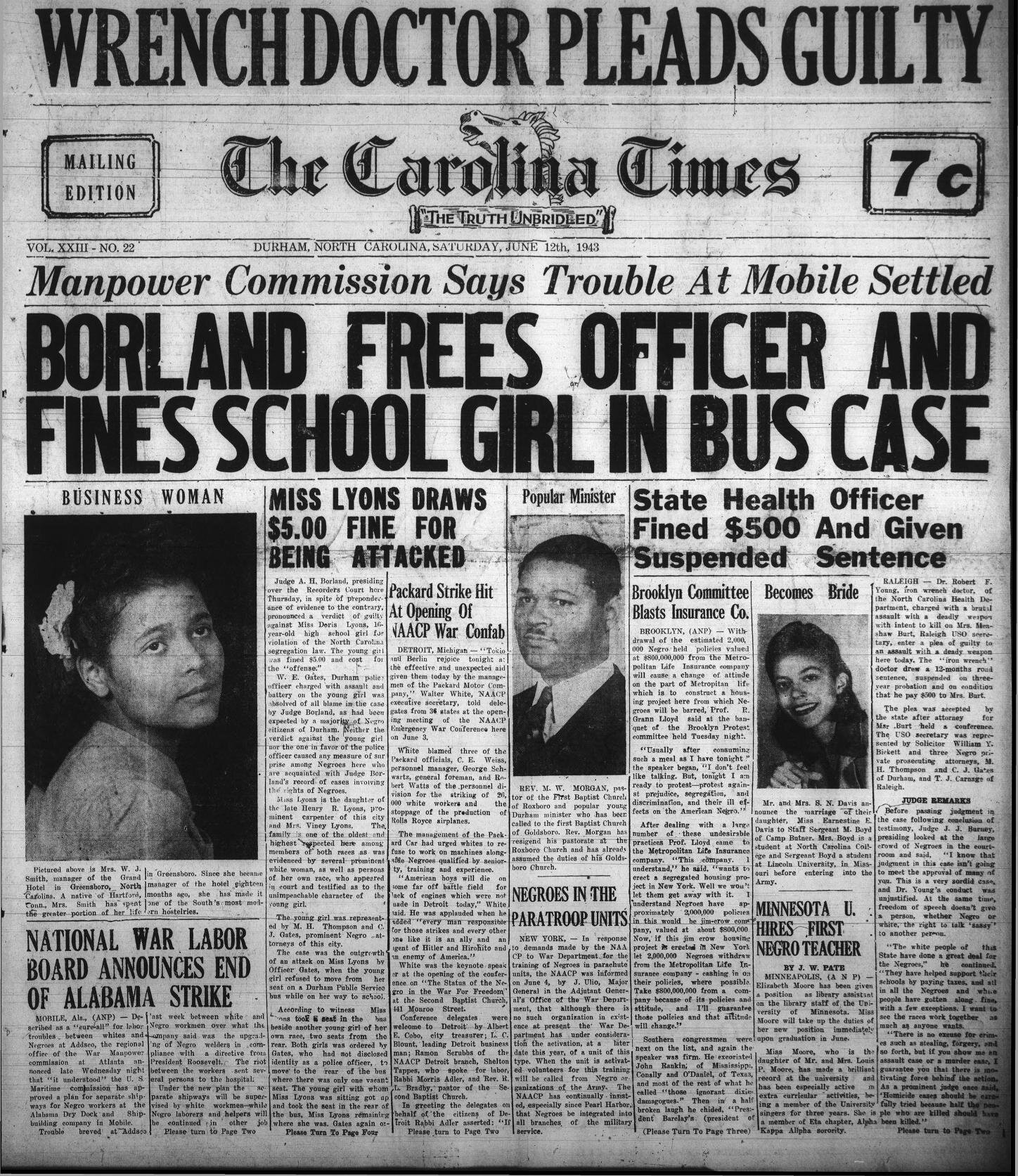
NC Digital Library
In 1943 Doris Lyon had refused to move to the back of the bus and was subsequently assaulted by a white police officer. She reportedly struck this police officer after he had tried to remove her from her seat on the bus forcibly. However, in court, there were esteemed white women who appeared in court and vouched for Doris' "unimpeachable character." Black leadership in Durham had rallied behind her as well, but Doris was still found guilty of assault and battery. Additionally, she was fined for breaking north Carolina's segregation law. No action was ever brought against the police officer who assaulted her. Individual acts of resistance and defiance, like Doris' story, is what led to building collective conscious and more organized protests in opposition against the discrimination and segregation that black people faced during this time. In 1938 a few years prior, a Durham woman brought a case against the local bus company when a white male passenger demanded that she move to the back of the bus. The Durham NAACP failed to take her case. However, the court ruled in her favor ruling that she had not broken violated the Jim Crow laws not that segregation was unconstitutional.
Sources:
A Song in a Weary Throat by Pauli Murray
Our Separate Ways by Christina Greene
Picture: http://newspapers.digitalnc.org/lccn/sn83045120/1943-06-12/ed-1/seq-1/print/image_665x817_from_1001%2C1396_to_3339%2C4268/