
#BlackWomeninBullCity | Pauli Murray
““It has taken me almost a lifetime to discover that true emancipation lies in the acceptance of the whole past, in deriving strength from all my roots, in facing up to the degradation as well as the dignity of my ancestors.” Pauli Murray ”
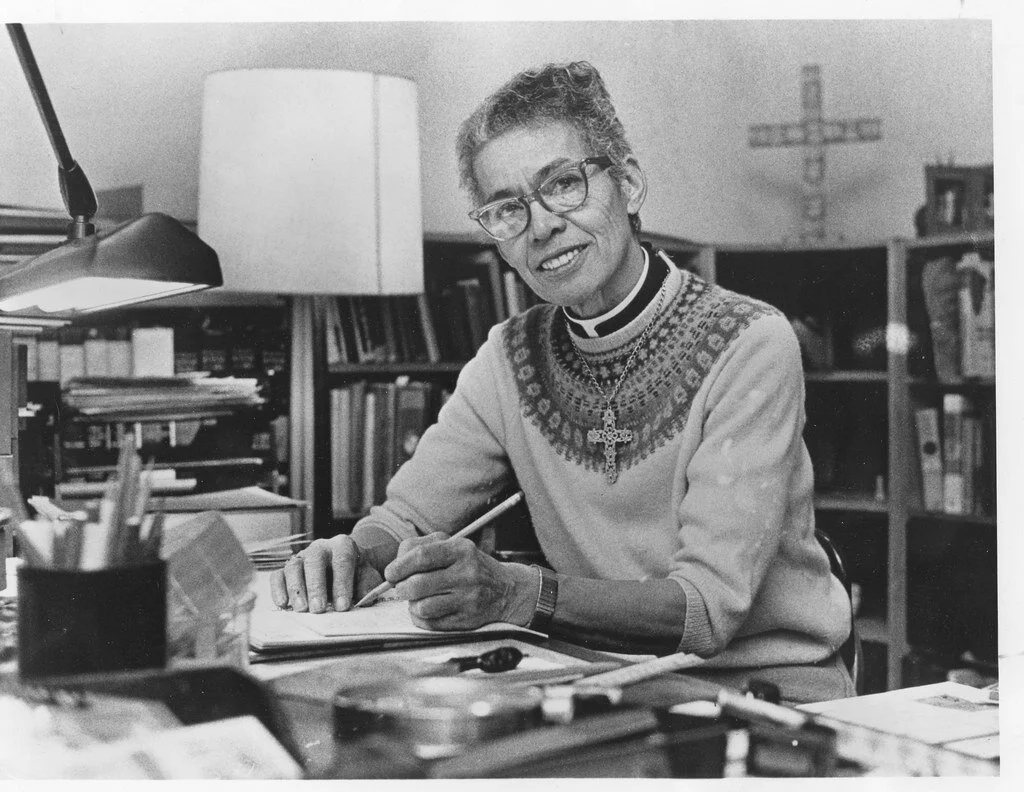
I hope the stories that I've been sharing of women from Durham have been enlightening and insightful for those of you reading. As much as you may think that I have known these women my entire life, the reality is that I have not. I had never heard of any of them. I found myself somewhat disappointed that having been raised in Durham and also educated in the Durham Public School system, I never received a thorough education in Durham's history and the people and their impact aside from knowing about Black Wall Street. However, I'm grateful to possess the historical and intellectual curiosity about my history that inspired me to begin this journey of discovering more about my roots. This week I'm back with a brief post about an exceptional woman that I found in my readings, and her name is Pauli Murray. Ms. Murray was a poet, activist, attorney, professor of law, and the first African American woman to become an Episcopal priest. What I found so striking about her story is that Ms. Murray was not born in Durham but moved to what she had called a "frontier town" at the age of three from Baltimore in 1914. She grew up in her grandfather Fitzgerald's home on Carroll Street. She attended West End School, which she explicitly recalls being one of her earliest realizations that what they received as negro children was different from that of the white children. Stating that "it wasn't the hardships that hurt but rather the contrast between what we had and what the white children had.
“ I'll never forget West End School. It was a rickety old wooden built building with the paint peeling; I can see those scales now. You know how wood or shingles or paint blisters and I can see it. When there was a wind in a storm, you could just hear the wind blowing through that old building. I think that it was a two storey building, it might have been a three storey building, but anyway … And of course, the white kids school, a nice brick school sitting in a lawn surrounded by a fence. West End was up on a sort of clay, barren ground. There was no lawn whatsoever. It just sat on clay. The fact that I can remember this today and I can see that old school building there, no swings, nothing to play with when you went out …”
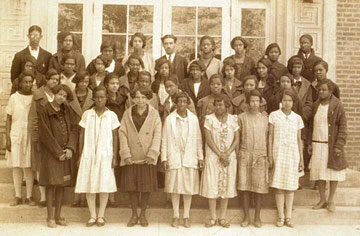
1926 Hillside High School
From an early age, she had a disdain for segregation, and all she wanted was to get away from it. Murray attended Hillside High School, formerly known as Hillside Park High School. She graduated from Hillside with a certificate of distinction. She would later attend Hunter College in NYC, although she had received a scholarship to Wilberforce University she did not want to attend any segregated schools.
“When I graduated from high school with honors, the Wilberforce Club got together and bestowed a scholarship upon me to go to Wilberforce and I turned it down.
…No more segregation for me. I was fifteen, but that I knew.”
Perhaps one of Pauli's most significant events was her 1938 campaign to enter into UNC-Chapel Hill's graduate program, where she was denied admission solely based on race. It received public attention, and she had sent off a letter to President Roosevelt, and although he did not respond, Eleanor Roosevelt did. The two would develop a long-standing relationship.
They sent me an application blank and they had written into the printed application blank, race and religion. This has been typed in so that it stands out apart from a normal form. I think I answered it but may have said, "But what difference does it make?" Obviously tongue in cheek. In due course, I got back a letter from Dr. Frank Graham, who was the then president of the University of North Carolina, saying, "I'm sorry, but the constitution and the laws of the state of North Carolina prohibit me from admitting one of your race to the law school.
This event was followed by Murray’s involvement to desegregate public transport, which resulted in her being arrested in March of 1940 on a bus ride from Washington to Durham and subsequently being convicted for resisting segregation on an interstate bus. Murray says:
They charged us with creating a disturbance, breaking the segregation law, violating the segregation law and creating a disturbance.
A year later, she would attend Howard University School of Law and later became a field secretary of the Workers Defense League concerning the case of Odell Waller, a black sharecropper convicted of first-degree murder of his white landlord by a white poll tax jury. She would also go on to help in a collaborative effort to form the Congress on Racial Equality. After working in the field of law for some time and serving her community in the fight for racial equality, she sought out a degree in law at Harvard, is that she had been awarded a fellowship, but they denied her entrance because of her sex. But it was actually at Howard that Murray says marked the beginning of her conscious feminism and awareness of sex and gender discrimination.
In 1956 Murray published Proud Shoes: The Story of an American Family, a biography of her grandparents, and their struggle with racial prejudice and a poignant portrayal of her hometown of Durham. It’s important to note that Pauli identified her self as a civil libertarian and person who was committed to advancing human rights wherever she went. During her time in Accra, Ghana, while serving as a senior lecturer at the Law School. Out of her experience in Accra, came a book that she co-wrote entitled, The Constitution and Government of Ghana. When she returned, she would be appointed by President John F. Kennedy to his Committee on Civil and Political Rights. While Murray worked closely with several prominent black male civil rights leaders, including Dr. Martin Luther King Jr. and Philip Randolph. She grew tired of the blatant dismissive attitude many of them had towards negro women and their role in advancing our rights in the fight for freedom. In 1963 she wrote to Randolph saying “been increasingly perturbed over the blatant disparity between the major role which Negro women have played and are playing in the crucial grass-roots levels of our struggle and the minor role of leadership they have been assigned in the national policy-making decisions.” Before she passed, Pauli Murray’s final accomplishment was In 1977, when she became the first African American woman to become an Episcopal priest.
Today you can see murals of Pauli Murray as part of the Face Up: Telling Stories of Community Life, a collaborative public art project in Durham, North Carolina. Artist, Brett Cook, led it.
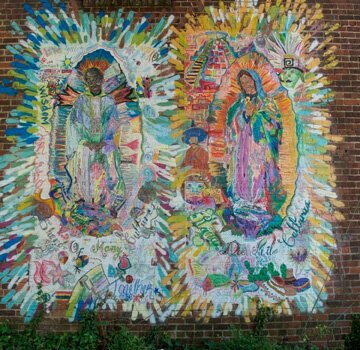
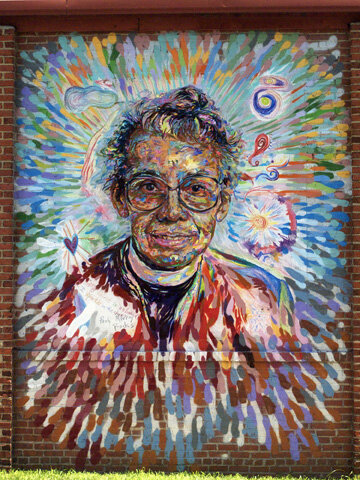
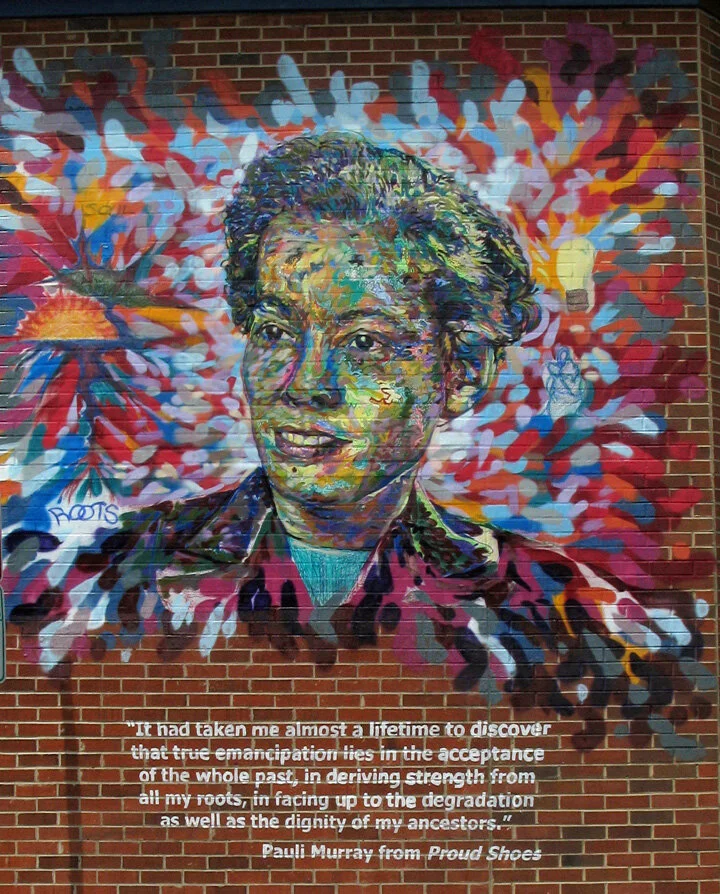
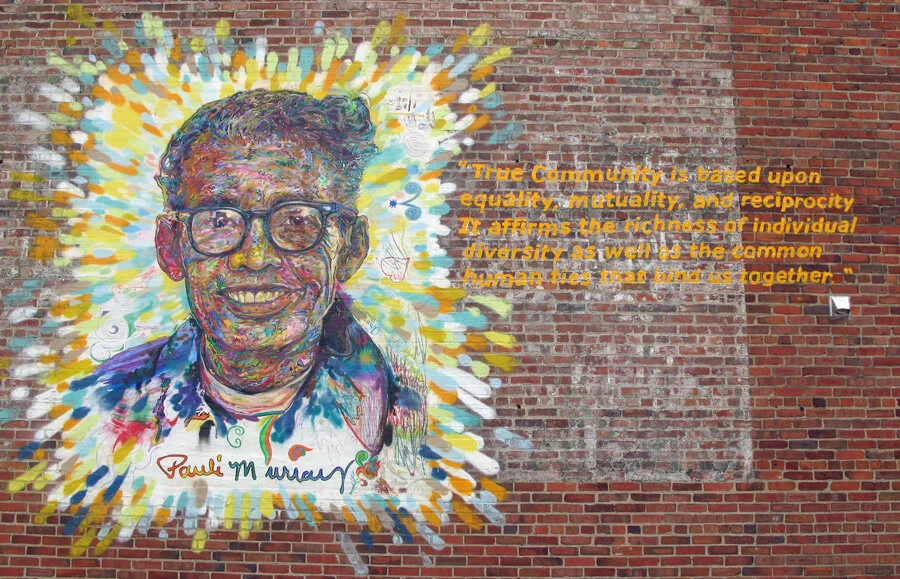
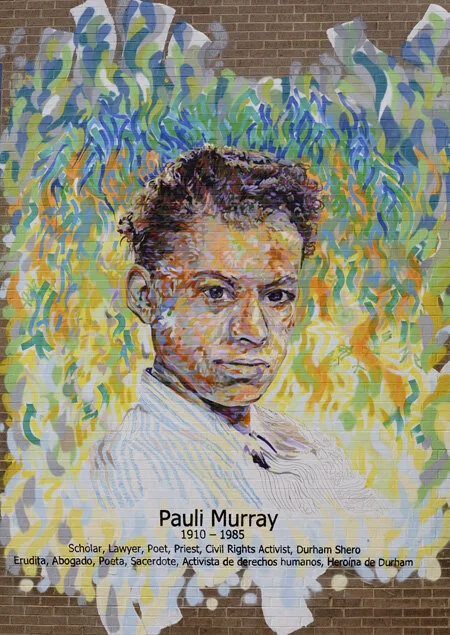
One thing I’ve grown to admire about Pauli Murray through my research on her life’s work is her undeniable resiliency and persistence in the pursuit of her own freedom. She did not back down no matter what stood in her way. She was so progressive for the time in which she lived. Pauli Murray had truly emancipated her mind and was determined to not accept an inferior position in this world because of the color of her skin or the fact that she was a woman. If you’d like to read more about her or read her work please check out some of the resources below.
Thanks for reading and learning with me!
Love Light and Peace.
Sources:
Our Separate Ways by Christina Greene
Interview with Pauli Murray, February 13, 1976.
Interview G-0044. Southern Oral History Program Collection
https://docsouth.unc.edu/sohp/G-0044/G-0044.html
https://paulimurrayproject.org/
Pauli Murray’s Writing’s:
“An American Credo.” Common Ground 5, no. 2 (1945): 22-24.
“And the Riots Came.” The Call, Friday, August 13 1943, 1; 4.
“A Blueprint for First Class Citizenship.” The Crisis 51 (1944): 358-59.
Dark Testament and Other Poems. Norwalk, CT: Silvermine, 1970.
Human Rights U.S.A.: 1948-1966. Cincinnati, Service Center, Board of Misions, Methodist Church, 1967.
“Negro Youth’s Dilemma.” Threshold, April 1942, 8-11.
“Negroes Are Fed Up.” Common Sense, August 1943, 274-76.
Proud Shoes: The Story of an American Family. New York: Harper & Row, 1978.
“The Right to Equal Opportunity in Employment.” California Law Review 33 (1945): 388-433.
“Roots of the Racial Crisis: Prologue to Policy.” J.S.D., Yale University, 1965.
Song in a Weary Throat: An American Pilgrimage. New York: Harper & Row, 1987.
States’ Laws on Race and Color. Cincinnati: Women’s Division of Christian Service, Board of Missions and Church Extension, Methodist Church, 1951.
“Three Thousand Miles on a Dime in Ten Days.” In Negro Anthology: 1931-1934, edited by Nancy Cunard, 90-93. London: Wishart and Co., 1934.
“Why Negro Girls Stay Single.” Negro Digest 5, no. 9 (1947): 4-8.
Murray, Pauli, and Henry Babcock. “An Alternative Weapon.” South Today, (Winter 1942-1943): 53-57.
Murray, Pauli, and Mary O. Eastwood. “Jane Crow and the Law: Sex Discrimination and Title Vii.” George Washington Law Review 34, no. 2 (1965): 232-56.
Murray, Pauli, and Leslie Rubin. The Constitution and Government of Ghana. London: Sweet and Maxwell, 1964.